
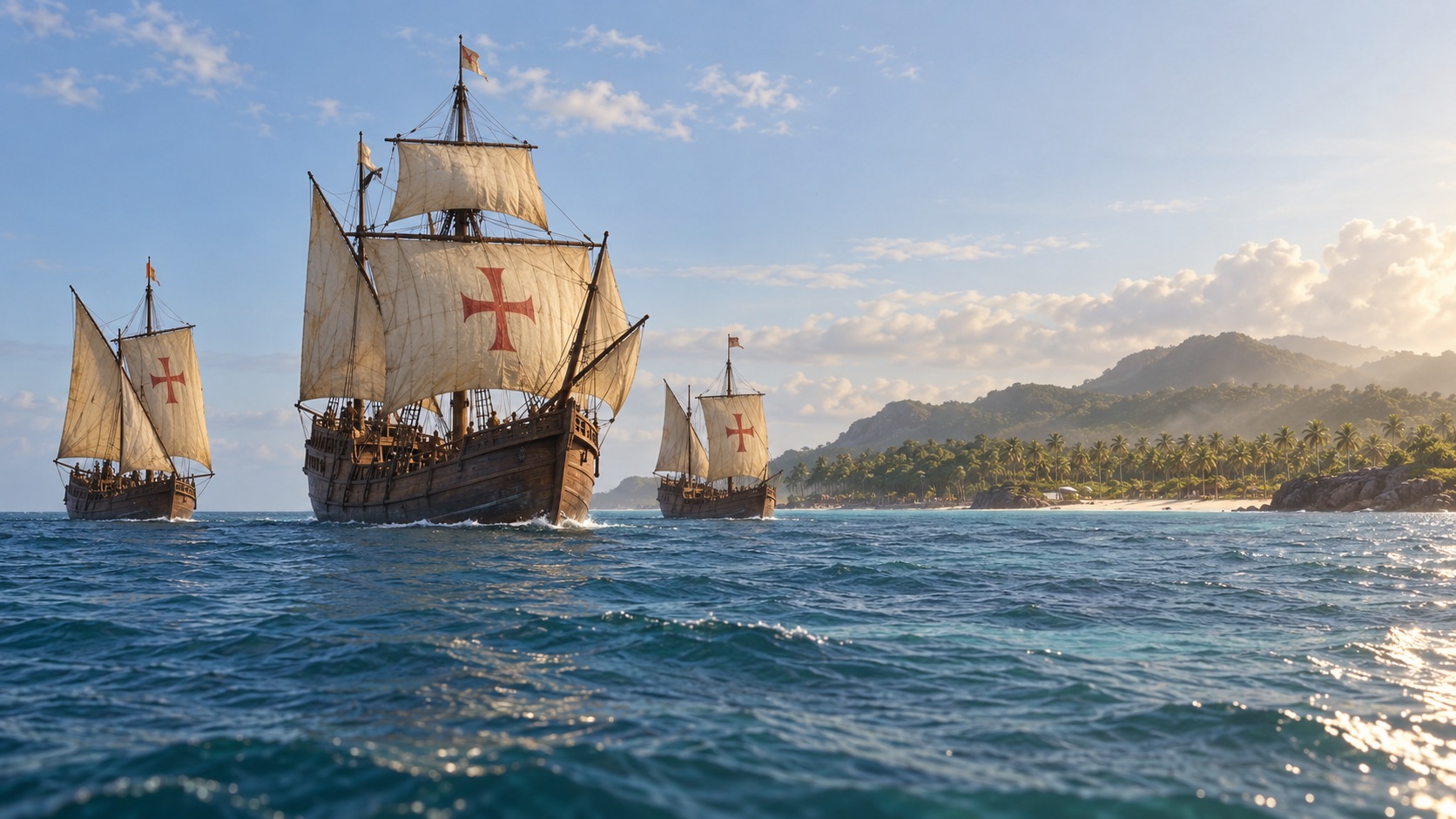
The origins of this date go back to 12 October 1492, when Christopher Columbus’s expedition reached a Caribbean island known to its inhabitants as Guanahaní, which Columbus named San Salvador.
Columbus had departed from Palos de la Frontera on 3 August with three ships: the Santa María, the Pinta and the Niña. Backed by Spain’s Catholic Monarchs, the expedition sought a westward route to Asia.
An Event That Changed the World
The expedition’s arrival began an era of sustained contact between Europe and the Americas. The Americas had been inhabited for thousands of years by peoples with their own cultures, languages and political systems.
Food, animals, knowledge and customs subsequently crossed the Atlantic in both directions. Conquest and colonisation also brought warfare, subjugation, displacement and devastating losses among Indigenous populations, particularly through introduced diseases.
From Commemoration to National Holiday
In 1892, marking four centuries since Columbus’s voyage, Spain declared 12 October a holiday for the commemoration.
In 1918, the date became a national holiday under the name Fiesta de la Raza. Decades later, the term Día de la Hispanidad became more widespread and was officially recognised in Spain in 1958.
Law 18/1987 established 12 October as Spain’s National Day, its current legal designation, although it remains popularly known as Día de la Hispanidad, or Hispanic Day.
A Date with Different Interpretations
The commemoration has evolved differently across the Americas. Some countries emphasise cultural and linguistic ties; others focus on cultural diversity, Indigenous peoples and the consequences of colonisation.
The history of 12 October therefore brings together an event of global significance and different ways of remembering its legacy.